
Queen Nefertiti of Ancient Egypt's 18th Dynasty Funeral Mask

Queen Nefertiti of Ancient Egypt's 18th Dynasty Funeral Mask

Indian Shiva Nataraja Igneous Rock Statue from the Chola Period

Indian Shiva Nataraja Igneous Rock Statue from the Chola Period

Shiva is one of the three main gods of Hinduism. Its predecessor was the god of reproduction, "Beast Lord," and the god of Vedic storms, Tatra, during the Indus Civilization era. It had a dual personality of reproduction and destruction, creation and destruction, presenting various bizarre and bizarre appearances, mainly including the Linga, Gentle, Superhuman, Dance King, Rika, and Half Girl. Linga is the most basic symbol of Shiva. Like many gods in mythology, due to Shiva's omniscient and omnipotent nature, her gender is not fixed, but changes at any time according to her different appearances. In Buddhist literature, Shiva is referred to as the Great Self in Heaven, residing at the top of the realm of colors, and is the ruler of the three thousand realms.
The wooden carving of the Haida totem pole from the indigenous Haida civilization in Canada

The wooden carving of the Haida totem pole from the indigenous Haida civilization in Canada

The wooden carving depicts a beaver holding a chewing stick with crossed shadows on its tail. Beavers symbolize creativity, artistry, and determination, and were made around 1860. It is now a collection of the Cambridge Museum of Archaeology and Anthropology. The homeland of the Haida people is located in the Queen Charlotte Islands off the Pacific coast of Canada, separated from the Black Carter Strait and the North American continent, and facing the Alexander Islands of Alaska across the Dixon Strait. It stretches nearly 300 kilometers along the province of Alberta in northwestern Canada. The Haida people did not have writing before, they recorded the stories and legends of their ancestors through carving totem poles.
Roman Empire period marble statue "dance muse"

Roman Empire period marble statue "dance muse"

This marble statue is the work of ancient Rome in the 2nd century AD and is now in the museum in Copenhagen, Denmark. The rotation movement emphasized by the right hand holding the cloak indicates that the woman is dancing. She's the muse, the muse of dance. The muse in Greek mythology is the muse of sacred poetry, sacred hymns, dance and eloquence, and agriculture and pantomime. She is depicted as very serious, contemplative and meditative, often putting her fingers to her mouth, wearing a long cloak and veil, and resting her elbows on a post. It is also sometimes considered the muse of geometry and meditation. Museum in Copenhagen, Denmark
The Golden Wood Carving of Compassionate Avalokitesvara from the Jin Dynasty

The Golden Wood Carving of Compassionate Avalokitesvara from the Jin Dynasty

This Bodhisattva statue is a cultural relic in Shanxi Province, China, from the Jin Dynasty, around 1200 AD. Its name is "Avalokitesvara of Mercy". The decoration of the statue is very fine, made of wood, with traces of gold and multi-color on it. The statue is the image of the Bodhisattva of Guan Shi Yin, who is the Bodhisattva of compassion. Bodhisattvas are the central element of Mahayana Buddhism. They are people who have reached a high degree of enlightenment. They help others to reach enlightenment and postpone their own enlightenment on the road to Buddhism. This work shows two intertwined dragons and a remarkable necklace. This statue is now in the Museum of Art History in Brussels, Belgium.
Plaster statue of the sculptor Joseph Ducacu, The Fall of Babylon
Plaster statue of the sculptor Joseph Ducacu, The Fall of Babylon

The Fall of Babylon is a work of art created in 1884 by Joseph Dukaju (1823-1891), now in the collection of the Royal Gallery in Brussels, Belgium. Babylon was an important city in the ancient Middle East, famous for its majestic walls and hanging gardens. However, the glory of Babylon did not last long. In 539 B. C., the Persian king, Serus II, captured Babylon, marking the end of the Neo-Babylonian Empire.
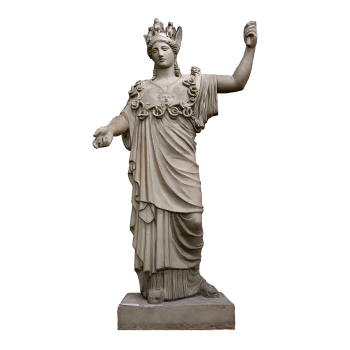
Late Roman period plaster replica statue "Bringing Hope-Athena of Farnese"

Late Roman period plaster replica statue "Bringing Hope-Athena of Farnese"

Bringing Hope-Farnese's Athena is a statue of Asina, a Roman plaster replica of a late 5th century BC Greek original. The design of the statue's intricate helmet was inspired by Asina Parthenon of the Parthenon. The repaired parts include the arms, the animal and cheek pieces on the helmet, and some amulet snakes. The statue has a height of 224cm and is now preserved in the National Museum of Naples.
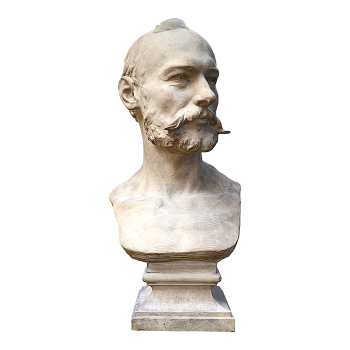
Plaster statue of sculptor Jill Lambert Goldshire "Andre Bust"

Plaster statue of sculptor Jill Lambert Goldshire "Andre Bust"

Andre Bust is a work of art created by Belgian sculptor Gil Lambert Goldshire, now in the Royal Gallery in Brussels, Belgium.
Korean Koryo period bronze clock "Buddhist temple bronze inscription ceremony clock"

Korean Koryo period bronze clock "Buddhist temple bronze inscription ceremony clock"

This bronze ceremonial bell is a Korean artifact from the Koryo period (918-1392). Its name is "Buddhist temple bronze inscription ritual bell". The decoration of this bell is very fine, made of cast bronze with engraved inscriptions, the bell was made in the 1200 AD generation. Once used as part of a Buddhist indoor ritual, the bell hangs in a Buddhist temple with a cast dragon on top and a vertical tube to amplify the sound. The inscription indicates that it was cast in the Year of the Dragon, took three years to make, and is now in the collection of the Cleveland Museum of Art.
The statue of kaolin during the reign of Ramapala, India "Skywalker Bodhisattva of Mercy"

The statue of kaolin during the reign of Ramapala, India "Skywalker Bodhisattva of Mercy"

The sculpture is an artifact from the reign of Bihar, Para Dynasty, Ramapala (1078 AD/79 to at least 1130 AD) in eastern India. The name is "Skywalker Mercy Bodhisattva. The sculpture is very finely decorated, made of kaolin with traces of pigment. This sculpture is the image of Avalokitesvara, a powerful and compassionate bodhisattva, sitting in an elegant posture with the image of Amitabha above his head. This image is a compassionate bodhisattva that brings liberation to evil spirits. To the right of Avallokitsvara is the Green Mother, holding a lotus flower in his hand, and to his left is the four-armed goddess, holding a rosary and a water bottle in his hand.
Joseon Dynasty Scroll Box "Painted Wood Dragon and Phoenix Scroll Box"
Joseon Dynasty Scroll Box "Painted Wood Dragon and Phoenix Scroll Box"

This set of scroll boxes is a Korean cultural relic from the Joseon Dynasty (1392-1910), and its name is "Painted Wood Dragon and Phoenix Scroll Box". The scroll box is very finely decorated. The scroll is printed with gorgeous dragon and phoenix patterns, mother-of-pearl inlaid on lacquered wood and twisted brass and copper wires. This scroll box is used by the royal family to keep scrolls or important documents. It measures 11.5 x 11.6 x 87cm (the scroll box was made from the 1700 s to the 1800 s) and is in the collection of the Cleveland Museum of Art.
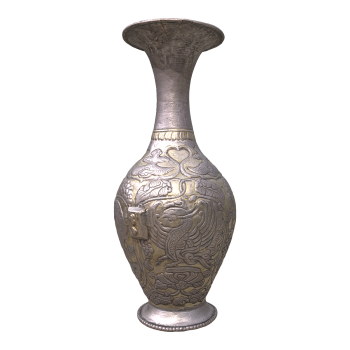
Tibetan silver vase during the Tang Dynasty "Tibetan gold-plated silver vase"

Tibetan silver vase during the Tang Dynasty "Tibetan gold-plated silver vase"

This vase is a cultural relic of the early 8th century AD from Tibet. Its name is "gold-plated silver vase". The decoration of this vase is very fine, mainly with Central Asian elements, including grape vines, bead edges and heart patterns. Sogite craftsmen are known to be adept at using gilded foil to set off silver relief designs. The form of the animal head-shaped drinking utensils and the use of silver are derived from Persian origins, while the rich, luxurious texture of the design and the form of the lion and the curly dragon on the side of the vase show an understanding of the Chinese form, which is proved in the early stage of political unity and integration in Tibet. This vase is now in the collection of the Cleveland Museum of Art.
Korean Dynasty blue and white porcelain "dragon blue and white porcelain jar"

Korean Dynasty blue and white porcelain "dragon blue and white porcelain jar"

This porcelain is a Korean artifact from the Joseon Dynasty (1392-1910). Its name is "dragon pattern blue and white porcelain jar". The decoration of this jar is very fine, including the underglaze blue dragon design. This jar was probably used as a vase in an official courtyard ceremony. It has an overall height of 39.5cm and a bottom diameter of 14.7cm. This jar was made in the 1700 s and is now in the collection of the Cleveland Museum of Art.
Korean Koryo period bronze basin "pilgrimage inscription bronze binaural basin"

Korean Koryo period bronze basin "pilgrimage inscription bronze binaural basin"

The charm of this relic lies in the fine decoration of its silver inlay: the five-character and four-line poem is intertwined with the image of the child. These poems, which evoke the concepts of no attachment and no duality, were written by Buddhist monks. One of the main decorative elements of this basin is that a child, probably a young Buddhist pilgrim named Sultanna, goes on a long spiritual journey in search of enlightenment. This bronze basin was made during the Koryo period (918-1392) between 1100 and 1200 AD. The basin was sold by London Gallery Limited to the Cleveland Museum of Art.
Pottery Figurines of the Zodiac in the Northern Wei Dynasty: Pottery Figurines Dog

Pottery Figurines of the Zodiac in the Northern Wei Dynasty: Pottery Figurines Dog

The Terracotta Warriors of the Twelve Palaces is a work of the Northern Wei Dynasty in China, made in the 500 AD era. This terracotta figure is made of gray terracotta, and there are traces on the surface that show that it was coated with slippery soil. This pottery figurine is part of the Zodiac series, and the animals represent the traditional concept of time in ancient China. This group of pottery figurines is currently in the collection of the Cleveland Museum of Art. The pottery figurines of the Northern Wei Dynasty showed the great confluence of the farming culture of the Han nationality in the Central Plains and the nomadic culture of the northern grassland at that time, as well as the new look of ancient pottery under the influence of the flourishing Buddhist statues and sculptures.
Pottery Figurines of the Zodiac in the Northern Wei Dynasty: Pottery Figurines Dragon

Pottery Figurines of the Zodiac in the Northern Wei Dynasty: Pottery Figurines Dragon

The Terracotta Warriors of the Twelve Palaces is a work of the Northern Wei Dynasty in China, made in the 500 AD era. This terracotta figure is made of gray terracotta, and there are traces on the surface that show that it was coated with slippery soil. This pottery figurine is part of the Zodiac series, and the animals represent the traditional concept of time in ancient China. This group of pottery figurines is currently in the collection of the Cleveland Museum of Art. The pottery figurines of the Northern Wei Dynasty showed the great confluence of the farming culture of the Han nationality in the Central Plains and the nomadic culture of the northern grassland at that time, as well as the new look of ancient pottery under the influence of the flourishing Buddhist statues and sculptures.
Pottery Figurines of the Zodiac in the Northern Wei Dynasty: Pottery Figurines Rat

Pottery Figurines of the Zodiac in the Northern Wei Dynasty: Pottery Figurines Rat

The Terracotta Warriors of the Twelve Palaces is a work of the Northern Wei Dynasty in China, made in the 500 AD era. This terracotta figure is made of gray terracotta, and there are traces on the surface that show that it was coated with slippery soil. This pottery figurine is part of the Zodiac series, and the animals represent the traditional concept of time in ancient China. This group of pottery figurines is currently in the collection of the Cleveland Museum of Art. The pottery figurines of the Northern Wei Dynasty showed the great confluence of the farming culture of the Han nationality in the Central Plains and the nomadic culture of the northern grassland at that time, as well as the new look of ancient pottery under the influence of the flourishing Buddhist statues and sculptures.
The porcelain of the Joseon Dynasty "Carved Pollen Celadon"

The porcelain of the Joseon Dynasty "Carved Pollen Celadon"

This vase was classified as pink celadon, which flourished during the 1400s-1500s. Pink celadon is pottery decorated with iron-containing clay and white slippery clay. The fish pattern on this vase was made using the technique of engraving and scratching, which was very common in ceramic making during the Joseon Dynasty (1392-1910). The bottle is now in the collection of the Cleveland Museum of Art.
Ink Cake "Panlong Ink Cake" during Jiaqing Period of Qing Dynasty

Ink Cake "Panlong Ink Cake" during Jiaqing Period of Qing Dynasty

This piece of ink cake is from China during the Jiaqing period (1795-1820) of the Qing Dynasty. The ink cake was green and shaped like a spiralling dragon. Ink cake (also called ink block) is dissolved in water and then ground into liquid ink on the surface of a square stone, which is used in painting and calligraphy. However, this precious piece of ink cake has never been used. the inscription on the side of the blue ink cake says that this set of ink cake was commissioned by governor chen huai of jiangxi province. This inset box is now in the collection of the Cleveland Museum of Art.
Bronze statue of the Chola period in Tamil Nadu, South India Shiva, King of Dance
Bronze statue of the Chola period in Tamil Nadu, South India Shiva, King of Dance

The statue is a work from the Chola period (900-1200 AD) in Tamil Nadu, South India, depicting Shiva, the king of dance. The statue measures: 113 x 102 x 30 cm overall and is currently in the collection of the Cleveland Museum of Art. In this statue, Shiva is depicted as the source of all movement in the universe. His dance of destruction is accompanied by the arc of flame, symbolizing the demise of the universe at the end of an era. Four hands hold different objects, including flame and drum, representing destruction and creation respectively. The right foot steps on a dwarf demon, symbolizing the smashing of ignorance.
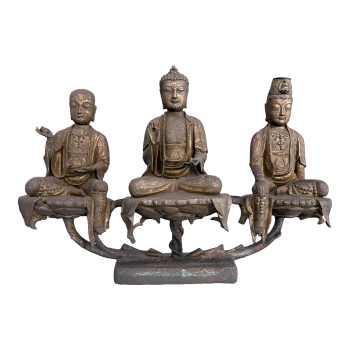
Bronze statue of the Joseon Dynasty "Three Amitabha"

Bronze statue of the Joseon Dynasty "Three Amitabha"

This relic is a bronze statue named Amitabha Three, made in 1400 AD. This statue is from the South Korea of the Joseon Dynasty (AD 1392-1910). This statue is made of bronze material with traces of gilding. The overall dimensions of this statue are 40.6 x 16.5 x 54.6cm. Among them, Amitabha Buddha sits in the center of the lotus seat. On his left and right sides are two waiters: Ksitigarbha Bodhisattva and Guanyin Bodhisattva. The combination of these three was popular in the early Korean period. This statue is now in the collection of the Cleveland Museum of Art.
Korean Koryo period inlaid porcelain "chrysanthemum and peony inlaid hip flask"

Korean Koryo period inlaid porcelain "chrysanthemum and peony inlaid hip flask"

This relic is inlaid porcelain decorated with chrysanthemum and peony patterns, made in the 1100 AD generation. Porcelain from the Koryo period (AD 918-1392) South Korea. This piece of porcelain is made of celadon and is decorated with white and black slip glaze. This piece of porcelain has an outer diameter of 15cm and a height of 18.8cm. The shape of this porcelain resembles a melon, inlaid with delicate chrysanthemum and peony patterns. In South Korea the flowers and leaves of chrysanthemum are used to make chrysanthemum wine. Chrysanthemum wine is enjoyed by people on the Double Ninth Festival (the ninth day of the ninth lunar month). This piece of porcelain is now in the collection of the Cleveland Museum of Art.
Classical Indian period igneous statue "Yoga goddess holding a jar (Yogini with a jar)"

Classical Indian period igneous statue "Yoga goddess holding a jar (Yogini with a jar)"

The statue is known as the "Yoga goddess holding a jar" and was made during the classical Indian period in the early 10th century AD. In the Indian subcontinent and many indigenous beliefs, the goddess is seen as the embodiment of life-giving energy. The goddess known here as yoga gracefully demonstrates complete control over the body. She holds a jar in her hand that may contain drugs, demonstrating her healing powers. Her now fractured left lower limb used to hold a skull cup for drinking. The sculpture was once enshrined in a circular open-air temple, along with at least 15 other goddesses, each believed to have unique powers, and is now in the collection of the Minneapolis Museum of Art.
Vessel in the Form of a Fish from the Middle Nazca Period

Vessel in the Form of a Fish from the Middle Nazca Period

Fish-shaped vessels were made from about 100 BC to 600 AD and are part of the Nazca culture. NASCAR artists are known for their bold, colorful designs. They are keen observers of the world around them and depict many plants and animals in their work, but they seem more concerned with capturing the spirit and vividness of the subject than naturalism. The image of this fish is highly abstract, the scales are suggested by strokes, and the gills are represented by streamlined lines. It is round and fat, proving a rich food supply. Fish is a key component of the Nazca diet and often appears in their art.